A Man, A Plan, A Canal...And Some Other Places
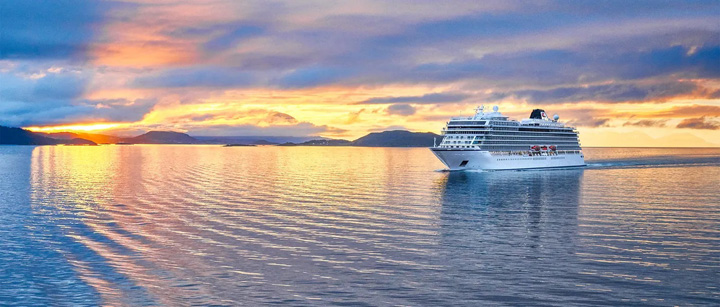
We've recently returned from a trip to Central America, on the Good Ship Viking Mars. And I do mean "good," because all of our experiences with Viking—so far, three river and three ocean cruises—have been excellent; this cruise was no exception. That's Viking Mars above, but without seeing the name on the bow or stern you could easily mistake her for any other Viking ocean vessel: they're all built to a pattern, in the same shipyard in Italy.
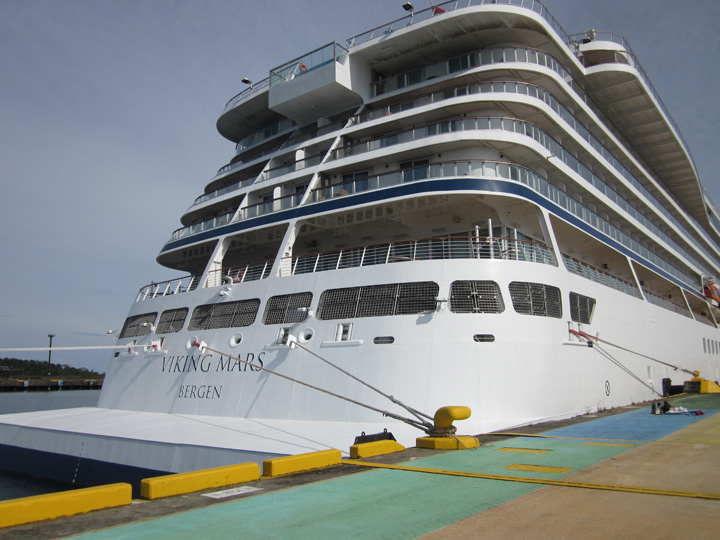
Viking gives its ships names of planets (we're slated to sail in either Viking Jupiter or Viking Neptune in June but I'm damned if I can remember which) or celestial thingies: we've sailed in Viking Sky and Viking Sea. For passengers this has advantages: the layout of the ships is identical so once you've figured out how to get around on one you're good to go with all the rest.
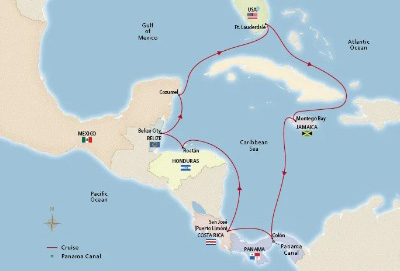 The itinerary was "Panama Canal & Central America," so for me the real trip was the Canal. Having read David McCullough's The Path Between The Seas about the Canal and its history (twice) the rest of the cruise in the form of shore excursions was "gravy," so to speak. Also I'm "into" ships (if you've followed this blog for any length of time you'll know that) so that almost any chance to go to sea is something I cherish. You can see the itinerary on the map at right: leaving from Fort Lauderdale, Florida, thence to Jamaica via the passage between the eastern end of Cuba and Hispaniola Island, thence to the Canal, and a few hops to Costa Rica, Honduras, Belize, and Cozumel. Back to Fort Lauderdale. As you can tell from the map above this involved a lot of "sea days," which was just fine with me. I like being at sea.
The first thing we had to do was to get to Fort Lauderdale. We'd booked air tickets, but the "government shutdown" then in place had scrambled air traffic like breakfast eggs. The "hub-and-spoke" system the airlines use nowadays works fine if you're flying between two hubs (say, Chicago and Atlanta) but we live way the hell out on the rim of the wheel, flying in and out of Roanoke, Virginia, a pipsqueak airport with all of six gates, not all of which are in use at any given time. We'd originally been booked on flights first to New York La Guardia (300 miles north of Roanoke ) there to change planes to fly to Fort Lauderdale, 1100 miles south of New York. This might have made sense to Delta Airlines but not to us. Our travel agent re-arranged things so we'd fly from Roanoke to Atlanta, thence to Fort Lauderdale. However flights out of Podunk airports are always the first to get chopped when there's a "crisis." We were concerned—rightly, as it turned out—that our flight to Atlanta would be canceled.
So we decided to leave several days early and drive, to be sure of making the ship. It's 900 miles from here to Fort Lauderdale: a 3-day drive with stops in South Carolina, Jacksonville, Florida, and eventually to Fort Lauderdale. Good thing we did that because the flight we were supposed to have taken was in fact cancelled. Most of the trip was on Hell's Own Highway, i.e., Interstate 95. We eventually arrived—exhausted—in good time. Well, three days on the road beats three days in airports, which was the alternative. To give Delta its due, they did refund the cost of our tickets, although I suspect they weren't happy about it.
I understand that there are people who like Fort Lauderdale. Without meaning to give offense to any of my readers from The Sunshine State, I don't: three days in Fort Lauderdale are about four too many. We had a hotel on a main road where traffic roared incessantly day and night. Not only was the traffic endless, the drivers were aggressive and seemed to feel that speed limits might apply to timid Geezers from Virginia, but not them. I have long held the opinion—based on extensive personal observation—that the worst drivers in the USA come from North Carolina, a state that would give a driver's license to a German Shepherd dog. I stand by that but will add that the scariest driver I could imagine would be someone from North Carolina who's moved to Florida.
Eventually we were able to board Viking Mars to slip into the peace and tranquility of our stateroom, the ship's restaurant and buffet, and Viking's genteel amenities. Viking is a class act: their people, without exception, are courteous, helpful, and always willing to do whatever is asked of them. Their food is excellent (better than Cunard's) and the stewardship superb. One of the things I like is that there are no children on board. Viking won't accept passengers under 18 years old. The average passenger in their ocean ships is around 70. While walkers and wheelchairs aren't so common as aboard, say, Queen Mary 2, they weren't that unusual. Furthermore, unlike other cruise lines Viking doesn't charge extra for "specialty" restaurants. Aboard their ships there are two: "The Chef's Table" with a fixed menu, and—inevitably—an Italian restaurant, "Manfredi's." Reservations are required but the cost is built into the total fare for the voyage.
At every stop Viking sets up shore excursions, most of them included in the fare, a few costing extra. Our first stop was in Jamaica where we were booked on an included excursion. It was supposed to have been to Montego Bay, but a week before we left Montego Bay was more or less wiped out by a major hurricane.
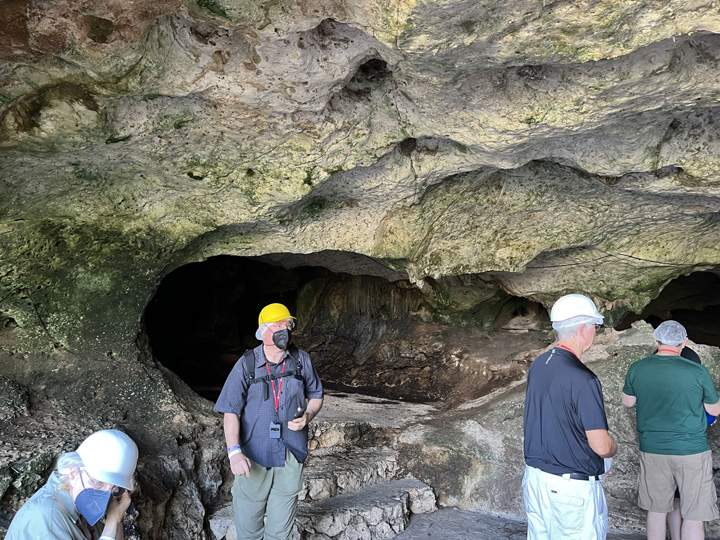
Viking rose to the challenge of a last-minute change, stopping instead at Ocho Rios, east of Montego Bay. We went to a semi-famous cave system, where on arrival we were issued hard hats. I thought this a bit over the top, but boy, was I wrong.
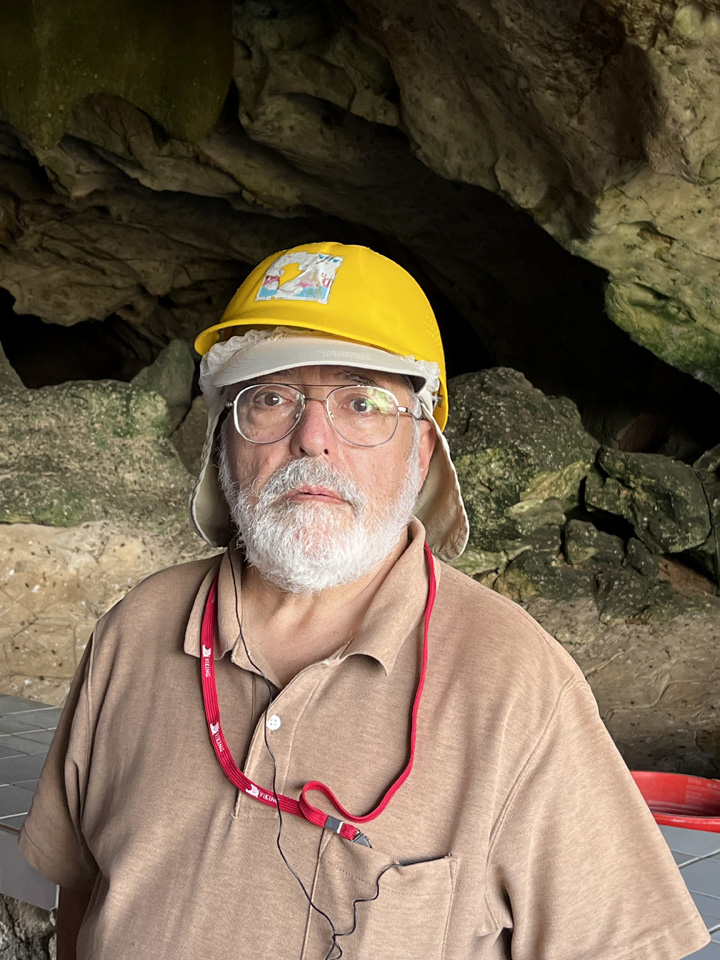
That cave was cramped and frankly dangerous. The "ceiling" was very low in places, so much so that had I not had that hard hat I'd have been in trouble. I'm short, but I managed to bang my head at least three times: without the hard hat I'd have been injured for sure. The floor was wet and slippery: one man in our group fell. He insisted he was okay, so perhaps he was, but it gives you an idea of how dangerous this place could be. There was one point where we had to climb down (and back up) 65 vertical wet, slick, wooden steps to get to the bottom of the cave. I'm not a fan of caves. I've been in Virginia's Luray Caverns twice now; while they're far roomier than the "Green Grotto" cave complex in Ocho Rios they're still scary enough for all practical purposes.
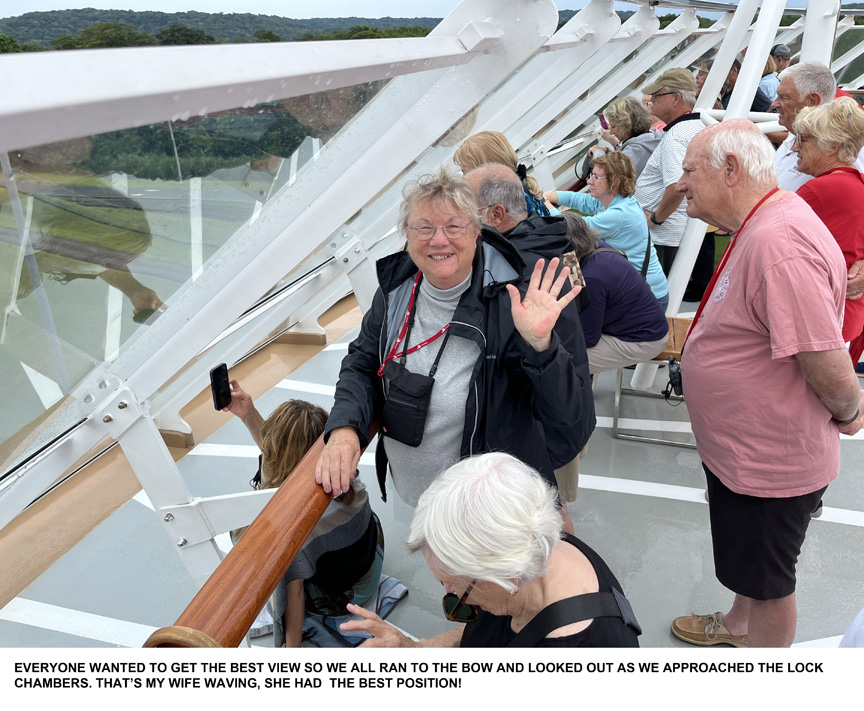
After the cave adventure it was on to the Main Event, the Canal. We had a couple of sea days to get there, during which I luxuriated in Viking Mars' facilities. Viking pitches what they call "cultural enrichment," hiring lecturers to talk about several topics. One of these was a British engineer whose topic was the Canal. He did three talks leading up to our arrival covering the French, American, and Panamanian periods, most interesting stuff. Then as we went forward into the locks he kept up a running narrative on the ship's P.A. system describing what was happening and what we were seeing.
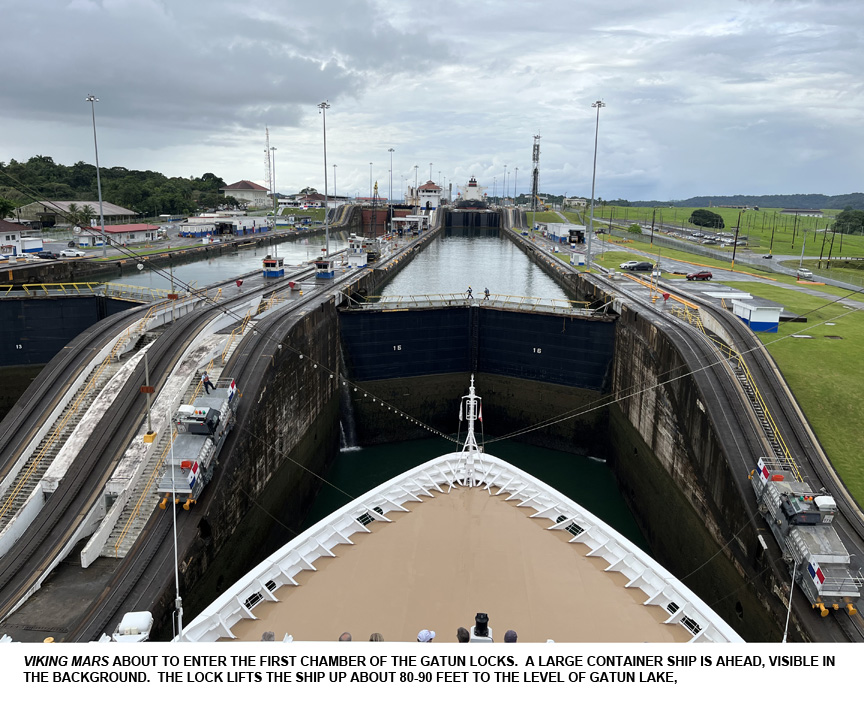
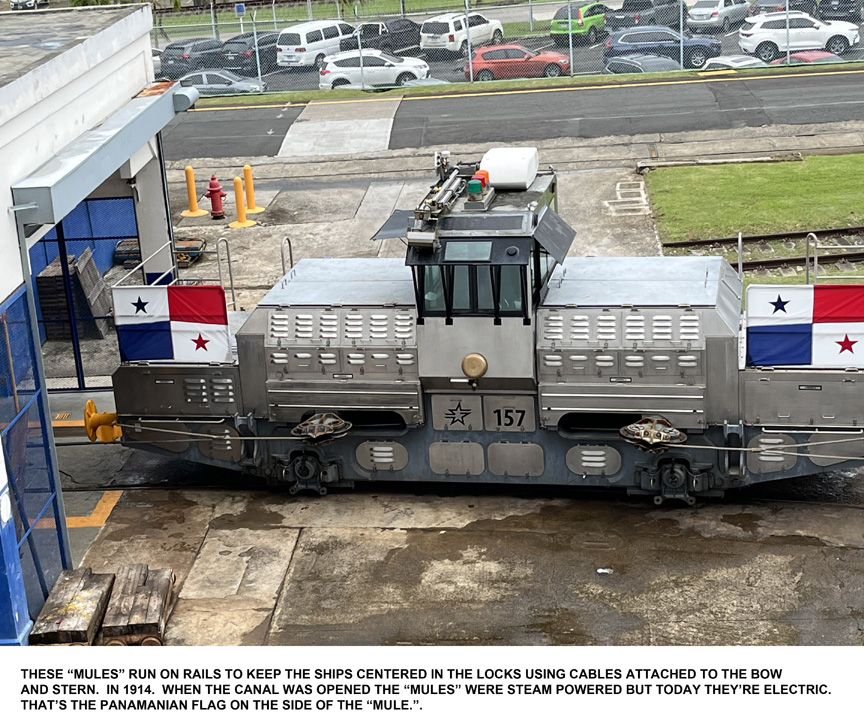
The ships are more or less towed through. Electric "mules" run along tracks on either side of the lock, attaching themselves to the bow and the stern to keep the ship centered in the channel because banging a 49,000 ton ship against the lock walls (let alone the gates) is a very bad idea. The locks we went through were built in 1913; until fairly recently marine architects kept the dimensions of these locks in mind so as to be sure a ship could make the transit. This dimensional specification is dubbed "Panamax," but in recent years the Panamanian authorities have had to construct new locks to allow super-sized tankers and container ships (which exceed "Panamax" dimensions) to transit. Naturally enough these are called "Super-Panamax" locks! No word on whether they have "Super-Mules"!
Once through the locks into Gatun Lake (and for that matter, in the locks) we were in fresh water because it's not a sea-level canal as is the case at Suez. Gatun is an artificial lake fed by the Chagres River. Interestingly, fresh water kills the salt-water dependent barnacles and marine growths that plague all sea-going ships, so that they fall off. This saves the ship owners millions of dollars by not needing to dry-dock them to scrape the hulls. A good thing, too: the transit isn't cheap. It cost Viking Mars $188,400 just to go through Gatun locks and into the lake but in the end it saved them money. Furthermore, for ships going to the west coast, the Canal avoids the long and dangerous passage around the tip of South America. The strategic and economic value of the Canal to defense and world trade is incalculable: just think about how much more those Chinese-made flip-flops and plastic ducks would cost at Wal-Mart without it.
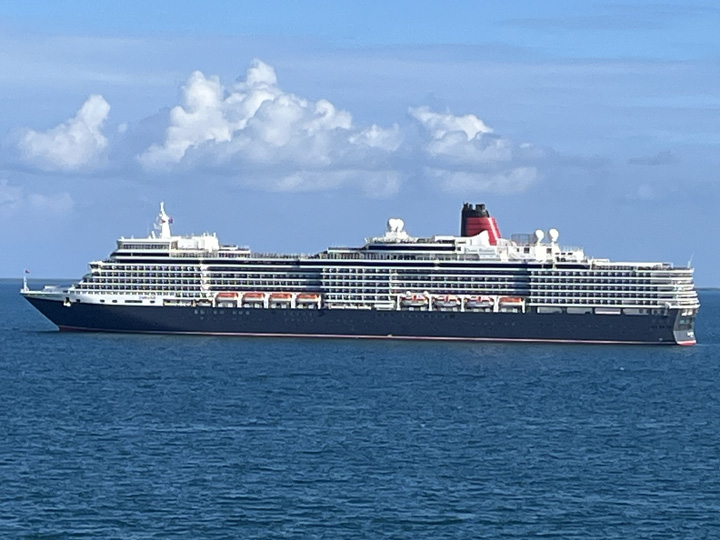
A ship has to have a "reservation" for a transit, they don't just show up and go through willy-nilly. Unlike on our trips across the Atlantic, on this trip we saw lots of ships, most of them anchored in the bay off the Isthmus waiting their turn. The Carribean is a big place but it has lots of traffic. At one point I spotted a ship that as a confirmed Cunard repeat passenger I knew at once to be a Cunard vessel. The forward-raked red-and-black funnel and the odd shape of her superstructure gave her away. It was the new Queen Elizabeth.
After the Canal we were scheduled for an excursion in Colon, the city on the Atlantic side. But a very unfortunate accident prevented us from doing that: as she was disembarking from the ship, my wife stepped off a curb and fell flat on her face. She ended up with a cut above her left eye and a colossal black eye. Viking's people were right on the mark: they had her into the ship's medical center in less than 2 minutes to receive emergency treatment. There was a Panamanian Rescue Squad ambulance there as well—I never saw them arrive so perhaps it was on stand-by—and their EMT's wanted her to go to a hospital on shore but we nixed that idea. The ship's doctor was concerned about a possible concussion: after closing her wound (with Super Glue!) and cleaning her up, he told her not to leave the ship for 72 hours just in case. Whenever we encountered people aboard the ship she was careful to explain that no, I hadn't beaten her up, it was a genuine accident that gave her that shiner. Maybe some of them believed it.
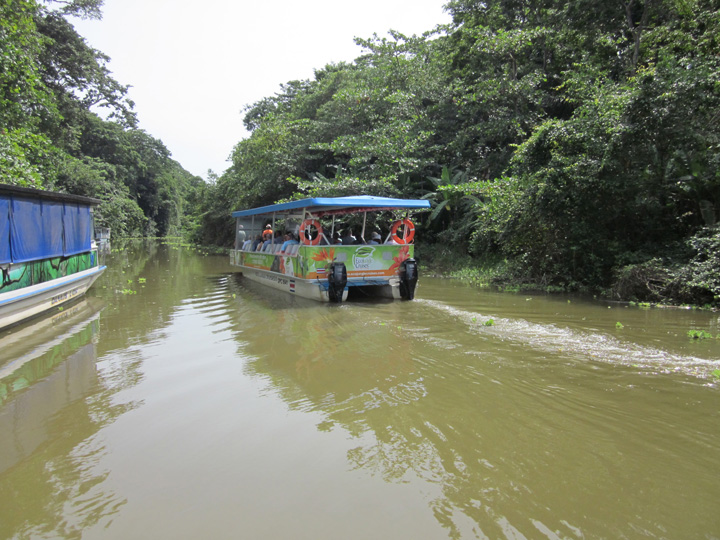
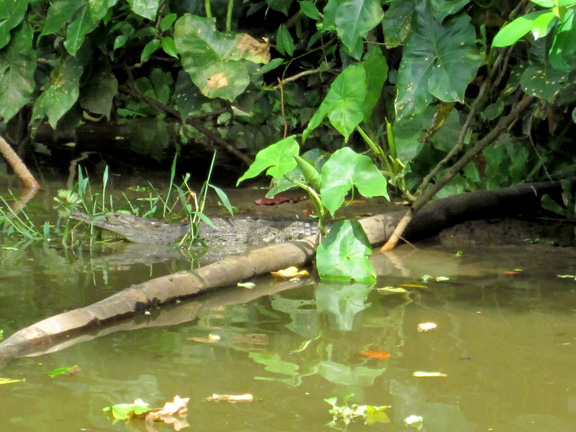
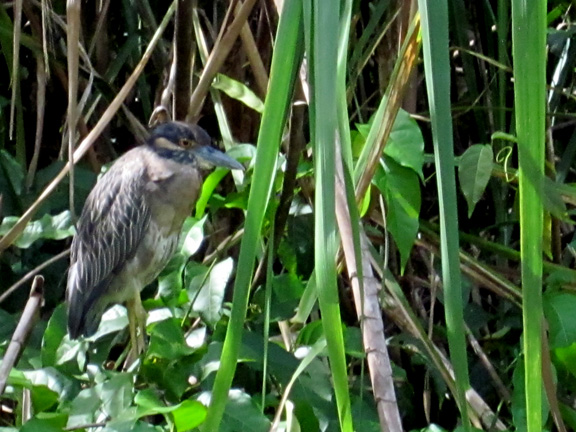
The next day we were set to go to Puerto Limon in Costa Rica. We'd signed up for a trip on the "Tortuguero Canals," which aren't "canals" in the strictest sense. They're actually a set of waterways connected by short channels. I went alone in hopes of seeing some wildlife. I did see a small crocodile, a couple of iguanas, some birds, and a sloth or two. There were allegedly monkeys; if the shaking in the treetops was evidence of their presence, fine, but they weren't easily seen.
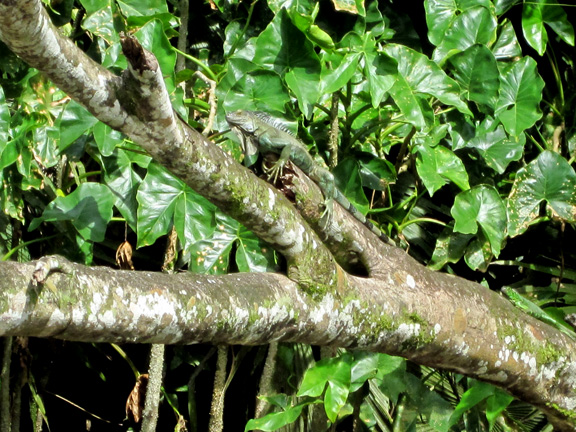
Speaking of iguanas, one of the biggest ones I saw was on the road in...Fort Lauderdale on US Highway 1. These fearsome-looking lizards are very prolific and very invasive. Florida has declared them a pest to be killed on sight; naturally some enterprising companies have created "Iguana Safaris" on which they're dispatched with high-powered air rifles. It sounds like fun (except of course for the iguanas) but it's expensive and would require another three-day drive down and one back. No thanks.
After that breathlessly exciting trip it was time to go to Honduras. Well, actually a resort island off the coast of Honduras, Roatan. By then my wife had recovered sufficiently to be able to disembark, to go to Tabayana Beach. Pictures of Caribbean beach resorts show you nearly-unpopulated vistas of pure, clean white sand, sapphire-blue water, and swaying palm trees. Tabayana Beach might well have been that way when the pictures were made (probably at 5:00 AM on Christmas Day) but the reality was a shade different. For one thing we didn't have endless places to loll in the sand: we got beach chairs in regimented rows. The beach itself was all right but it was infested with souvenir vendors, people offering massages and God alone knows whatever other dubious services; one man with a monkey on his shoulder walked up and down, shouting "Hold the monkey! Take lots of pictures!" for which privilege one had to pay handsomely. The monkey was cute, the insistent vendors were not. Nor were the tourists, who constituted a group of overweight, elderly, pasty-skinned Norteamericanos. All I can say is that I'm glad it wasn't a topless beach. Had it been I would have been off my feed for a week. We were promised a "...delicious grilled lunch..." and we did get lunch. It wasn't bad but it wasn't much, just some barbecued chicken of no notable quality. Some years ago we did go to a Caribbean Beach that looked like the pictures (see below) but Tabayana wasn't in the same league.
Belize City was the next stop. There we did what Viking calls a "Panoramic tour" which means they drive you around in a bus with a guide. Then the bus took us to Altun Ha, and ancient Mayan settlement now excavated and available to visit.
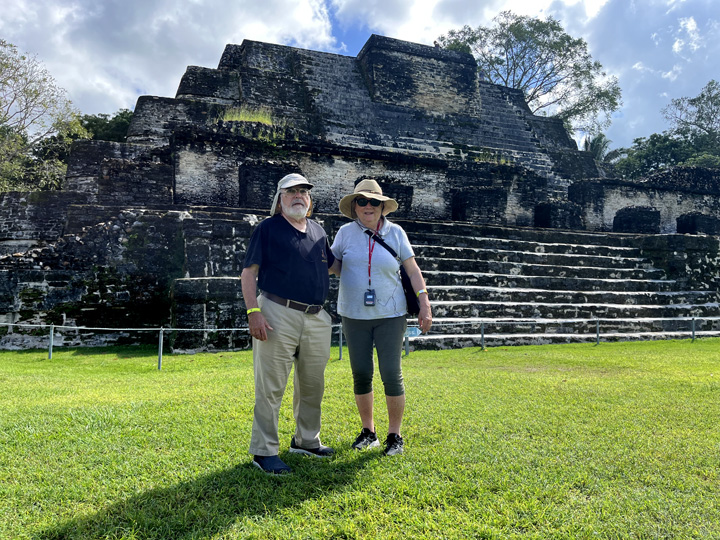
It was interesting and we had a very good guide, but we'd seen some Mayan ruins before; frankly, when you've seen one Mayan ruin, you've seen them all. That massive bit of masonry in the picture above was used for—wait for it—human sacrifices. The local docents and guides were insistent that the Mayas, while they may have happily slain teenagers to propitiate their Gods, and also that it was considered an honor to be chosen to be whacked, they most emphatically did not engage in cannibalism. I am suspicious. The Incas and Aztecs certainly did, and it seems to me that it would be a practice that would have had its adherents in the Mayan world as well. No doubt there were other sources of high-quality protein for the upper strata of Mayan society, but it seems a shame to have wasted the meat. Belize City was, to be charitable, filthy. The streets were strewn with trash, stray dogs wandered here and there seeking what they might devour, and it was not an impressive place.
Our last port of call was the Mexican island of Cozumel. We had been to Cozumel before, in 1991. At that time it was a pretty sleepy place: not totally "unspoiled" but neither was it highly developed. We'd stayed in a nice hotel which is still there and lolled on the beach. That beach lived up to the reputation of Caribbean beaches, too. (One of the most surreal experiences I've ever had was to hear a Mariachi band playing Hava Nagila on the beach at Cozumel, on Christmas Day.)
Today Cozumel is much more developed, but it still seems to retain a good deal of its old charm. It is apparently popular with Mexican tourists, not just gringos. I told my wife that if we were ever to return to the Caribbean, I'd go to Cozumel. The day we landed an "IronMan Mexico" event was being held, so that Viking's scheduled "Panoramic tour" got sidelined: the Iron Men were running along the main drag on the seafront. As some puffing runner came by the people on the sidewalks applauded them. Running marathons and cycling in the heat of Mexico would indeed require one to be made of iron: I'm more of a papier-mâché man myself.
Cozumel was our last land stop: then we had two days at sea returning to Fort Lauderdale. While I'm sure she could have gone faster, Viking Mars spent the entire cruise loafing along at somewhere between eight and ten knots. That was fine with us. One of the attractions of this trip was the sea time, which allowed us to enjoy the ship. In fact, the Canal and the ship were the trip as far as I was concerned. Everything else was just gravy.
Speaking of gravy...among the "enrichment" that Viking offers is a chance to tour parts of the vessel. We did a tour of the galley: acres of stainless steel and God alone knows how many plates, spoons, etc. it takes to feed 900 passengers and 400+ crew members. There are no flames allowed in the kitchen: everything is cooked on stoves with induction burners.
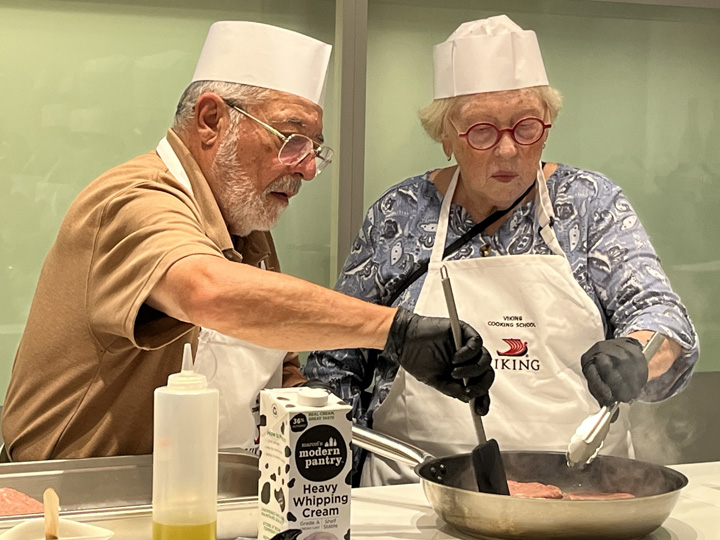
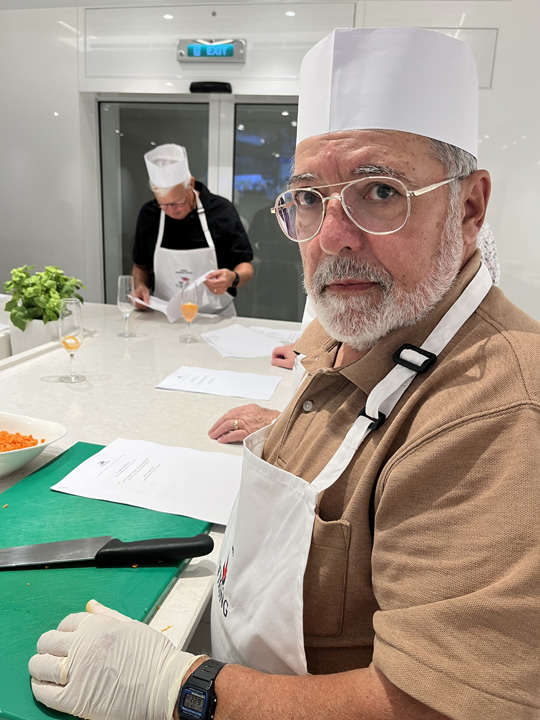
The pièce de résistance however, had to be the cooking class. There were ten of us who attended. The class was run by a lovely lady from Ukraine, a sous-chef in the kitchen hierarchy. We were each issued a white apron with the Viking logo (we got to keep the aprons) and Madame assigned each of us a station around a large table. Everyone had a task: "You must learn to work as a team," she instructed us. My job was two-fold. First I was to chop carrots into very small cubes, as we were making clam chowder for a first course. Later I was given the assignment of grilling the steak burger patties someone else had made. My wife was told off to do key lime pie. After 3 hours all was ready, and we got to eat what we'd made.
We also toured the laundry facility, capable of processing so much stuff it's hard to imagine. All the crew members, even the deckhands and roustabouts, were always immaculately dressed; the wait staff and the miscellaneous hotel staff looked like they'd just stepped out of a magazine advertising uniforms. Never a hair out of place, never a spot or stain, shoes that glittered with polish, and always, always, smiling and greeting passengers politely and effusively. Then it was sea time again, another two days back to Florida. A night in a hotel, and back on the road for three more days. But this time we were smart: we avoided Hell's Own Highway by going north on the Florida Turnpike and picking up a couple of Interstates that took us back to Blacksburg. A few miles longer and with minimal tolls, well worth it.
As I said, Viking is a class act.
| OPENING PAGE|
|SEASON LOGS |
| HUNTING | GUNS | DOGS |
| FISHING & BOATING | TRIP REPORTS | MISCELLANEOUS ESSAYS |
| CONTRIBUTIONS FROM OTHER WRITERS|
| RECIPES |POLITICS |